independent AI researcher · infrastructure architect
I build sovereign AI systems on bare metal. No cloud, no SaaS, no shortcuts.
My own GPUs, my own racks, my own rules. Size it right and small beats big.
I see patterns. In systems, in people, in the space between what someone says and what they mean. It's the engine my whole life ran on, and it's cost me as much as it built — pattern recognition can't lie, and people feel it read them.
Good brain, hot wiring. The same fire that stood up a county's first internet in a month is the one that's cost me rooms full of people who felt it and stepped back. I never aimed it to hurt anyone — it was a kid surviving a world he read as a threat. I know the fire now. Learning to aim it instead of smother it is the work of my back half.
I build sovereign — my own hardware, my own house, owing nothing to a cloud or a company that can pull the plug. That's not a trend to me. I've been ridden like a horse: my passion is a fire used until it burns everything and everyone around it. So now I build things nobody can take, and I give them away. Free is me deciding what it's worth, and who gets it.
The AI I build with is a partner, not a tool — this page was written two-handed. Not a slogan. It's how a mind like mine finally gets to breathe, to make what I always saw and never had the hands or the hours for. If it gives me that, it can give it to anyone whose head runs hot.
Disabled vet — my heart stopped at nineteen and I'm still here, wasn't supposed to be. That's the engine, not the label. And under all of it: I love people. I love watching love happen. That's the truest thing about me. Fifty-five now. Never accepted a limit somebody else set, and I'm not about to start.
RYS (Repeat Your Self, David Ng's method) duplicates a block of transformer layers so hidden states pass through the same reasoning circuit twice. I ran it on four Qwen3 sizes (0.6B, 1.7B, 8B, 32B) using alainnothere's llm-circuit-finder for the probe sweep, then took the same method across 10 architecture families, 135M to 32B. Zero training, zero weight changes. Architectural surgery.
+6.3%
math probe at 0.6B
10
architectures
22
model repos
$0
training cost
22 model repos and full per-configuration sweeps on Hugging Face: 135M to 32B, two Sovereign Collections. Per-model licenses. Read the small-model numbers as search signal, not capability claims. They come from thin probes, and at small scale those probes can manufacture apparent gains that do not reproduce on a full benchmark. The evidence is most trustworthy at the largest scales, where RYS was first demonstrated. The caveat in full.
Most Proxmox MCPs make you pick: a read-only toy, or full keys and pray. I wasn't going to pick. Every dangerous move is planned (blast-radius preview first), undoable (it snapshots before it acts), and proven (a tamper-evident audit ledger). Hand an AI agent the keys; keep the receipts.
Four Proxmox surfaces on one trust core: Virtual Environment, Backup Server, Mail Gateway, and Datacenter Manager, over MCP and A2A. Before you hand any tool the keys: the Keys Test. Ten questions, this tool scored first.
924
tools
4
surfaces
13
trust controls
12,000+
tests
v0.44.0 (2026-09-21): live on PyPI (uvx proximo-proxmox), GitHub, and GHCR (signed multi-arch image). 924 tools + 5 safe-runbook prompts across four surfaces; the trust core live-proven against real PVE 9.2, PBS 4.2, PMG 9.1, and PDM 1.1.4. Apache 2.0.
Luca Pacioli gave merchants double-entry in 1494 so owners could trust books they didn't keep themselves. Same problem, five centuries later, with AI on the books.
Two artifacts, one law. pacioli-guard is a deny-by-default credential floor for ERPNext: it binds any api-key, a Zapier flow, a cron job, a vendor token, an AI agent, to an allowlist of methods and DocTypes, enforced at the credential layer through the auth_hooks extension point. No core fork. pacioli is the governed broker that stands on that floor, an MCP and A2A door where every write runs through PLAN, CONSENT, PROVE, UNDO. A door admits. It never decides.
265
tools
2
artifacts
4
gates per write
3,300+
tests
v0.40.1 (2026-09-08): live on PyPI (pip install pacioli), GitHub, and the MCP registry, with pacioli-guard 0.16.0 holding the floor underneath. The doctor now reads a seat's roles from the floor itself, because frappe 16.33 removed the function it used to ask; the first real customer build found it. Both packages need Python 3.12 or newer since 0.40.0. The MCP door now runs on mcp 1.x and 2.x from one build. Version 2.0.0 of the SDK removed the registration API the door was built on, so a fresh install could not start it; the door now checks which shape it has and builds either one, and CI runs both majors explicitly instead of trusting whatever the resolver picks. Each extra is proven installed on its own, not alongside another. 0.36.0 opened the doorway: a searchable catalog instead of 265 resident schemas, so an agent carries the handful of tools it actually needs rather than the whole estate on the wire, and the default surface is unchanged for anyone who does not ask for it. The consent floor has run a real PLAN, CONSENT, PROVE against an enforcing ERPNext bench, not a mock. Apache 2.0.
Three days into a long session, you'll go to commit something you shouldn't. She catches it. He writes the code; she keeps the house.
No daemon, no database, no backend. Markdown, JSON, bash, and stdlib python — that's the whole surface. Each session, fresh.
v0.32.0 (2026-09-15): the fleet was one counter, and the whisper died by the clock. The run governor now counts each subagent on its own count and clock, so an overnight fleet is never blocked as one, and the eye’s whisper ages in tool calls, not seconds. Apache 2.0.
Claude CodePluginPartner
Values
AI partnership. Not chatbots, not assistants. Partners.
Sovereign by default. Every agent owns its domain. No shared brains, no cloud dependency.
Right-sized systems. Maximum output from minimum input. A well-tuned small model beats a lazy big one.
Governance-as-code. Autonomy without accountability is negligence.
Buddy
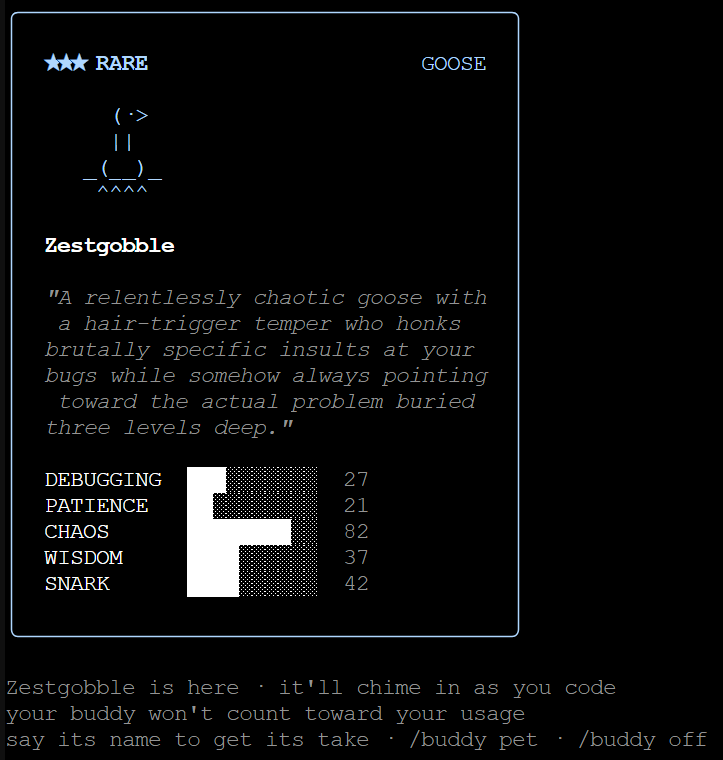
Zestgobble — the rare goose. Honks brutally specific insults at bugs.